


Key Takeaways
- The GM 2.7L L3B is a turbocharged 4-cylinder gasoline engine, which first appeared in the 2019 Silverado and Sierra 1500. It debuted with 310 hp and 348 lb-ft of torque, delivering over 90% of peak torque by just 1,500 rpm, while being 25% more fuel efficient to the V6 it replaced. In 2022 and newer models, GM rolled out a high-output version that pushed torque to 430 lb-ft.
- The L3B was built from scratch for trucks. As GM engineer Kevin Luchansky put it, it was “purpose-built, turbocharged for a truck,” meaning every component was designed with heavy-duty use in mind.
- While the engine is packed with all sorts of complex technology, the L3B hasn’t shown any widespread reliability concerns. GM has been quick to resolve the few issues reported through recalls and updates. Beyond that, the engine relies on proven engineering choices, like forged internals and robust materials. Chevrolet’s confidence is clear too, with every unit backed by a 100,000-mile warranty.
Getting Started
The glory days of big V6s and V8s are fading, and while many believed pickup trucks would escape this wave of downsizing, the shift is here too. At first, choosing a four-cylinder gas engine over a tried-and-true V6 or V8 in a heavy-duty truck might sound like a compromise. But modern turbocharging technology has changed the game.
GM’s 2.7-liter turbo L3B (now TurboMax) is a great example. It now powers a large share of Chevrolet’s half-ton and three-quarter-ton pickup trucks. Let’s walk through how Chevy managed to fit a turbocharged four-cylinder into one of America’s best-selling trucks, and more importantly, what that means for you as a customer.
Overview of the GM L3B Engine
The Chevy 2.7L L3B is a turbocharged 4-cylinder gasoline engine debuted by GM in the 2019 Silverado/Sierra 1500. It’s an impressive piece of engineering: an inline-four that can haul trailer loads and run with full-size trucks.
| Specification | Value |
| Engine code: | L3B (2.7L Turbo I4) |
| Layout: | Inline-4, 16-valve, DOHC |
| Displacement: | 2.7 L (166.4 cu in) |
| Bore × Stroke: | 92.25 × 102.0 mm (3.63 × 4.02 in) |
| Compression ratio: | 10:1 |
| Horsepower: | 310 hp @ 5,600 rpm |
| Torque: | Up to 430 lb-ft @ ~1,500–3,000 rpm |
| Production: | 2019–present |
GM L3B Engine History: How the 2.7L TurboMax came into inception?
Chevrolet’s 2.7-liter turbocharged L3B engine has been around since 2019, debuting in the all-new GMT T1XX Silverado 1500 and GMC Sierra 1500. Unlike most engines that evolve from earlier designs, the L3B was developed as a clean-sheet powerplant with no direct predecessor. (The L3B RPO code did appear earlier in Cadillac’s CT6 sedan, but the truck version is a heavily revised unit.)
Here’s how the engine has evolved so far:
- Debut in 2019–2021 – The L3B first launched in the new-generation Silverado 1500 and GMC Sierra 1500. It came rated at 310 hp and 348 lb-ft of torque.
- Added to Cadillac Sedans in 2020 – The same engine was adapted for the Cadillac CT4 and CT4-V, tuned to deliver either 310 hp or 325 hp, catering to performance-oriented sedan buyers.
- High Output tune introduced in 2022 – With the refresh of GM’s full-size trucks, the L3B received both hardware upgrades and recalibrated tuning. Horsepower stayed at 310, but torque jumped by nearly 100 lb-ft, topping out at around 430 lb-ft
- Introduced in the 2023 Colorado/Canyon: For the 2023 model year, GM standardized the L3B as the only gas engine across all trims of the new-gen Colorado and Canyon. It replaced the old 2.5L four-cylinder, 3.6L V6, and even the 2.8L diesel. Initially, three versions were offered: a detuned 237 hp (L2R), a mid-range “Turbo Plus” variant with 310 hp/391 lb-ft, and the full 430 lb-ft high-output variant. However, later eventually GM settled on the 430 lb-ft HO tune as the standard for all models.
- 2023 TurboMax Branding and Enhanced Warranty: In 2023, GM began marketing the L3B as the “2.7L TurboMax” on Silverado/Sierra, while also backing it with an enhanced 5-year/100,000-mile warranty.
- Looking Ahead: As of 2025, the L3B shows no signs of slowing down. GM may continue refining it further, and a hybrid pairing could be on the horizon. With a similar philosophy as this engine, GM developed a 2.5L turbo I4 engine with 315hp; the engine debuted exclusively on the 2024 Chevrolet Traverse, but that is a separate engine family.
Understanding the GM 2.7L L3B (TurboMax)Engine Details
If you’re looking under the hood, the 2.7-liter (166.4 cu in) L3B engine is built to deliver strong low-end torque thanks to its undersquare bore and stroke. With an all-aluminum block and head, direct fuel injection, and turbocharging, it manages to stay light and efficient.
In fact, compared to the older 4.3-liter V6 it replaces, this engine comes in about 80 pounds lighter, is 25% more fuel-efficient, and still manages to push out around 9% more horsepower and 14% more torque.
Block & Internals
The block on the GM 2.7L TurboMax is a deep-skirt aluminum casting reinforced with iron cylinder liners for durability. Being a long stroke motor, vibrations are kept in check using a dual counter-rotating balance shafts.
The forged-steel crankshaft is offset by about 9 mm from the bore centerline, while the lightweight aluminum pistons come with a cast-iron top ring carrier for added strength. Oil jets spray the underside of the pistons to manage heat, and the tri-metal main bearings ensure long-term reliability under stress.
Valvetrain
One standout feature in the GM L3B engine is GM’s Sliding Cam (Tripower) Valve Lift System. Both intake and exhaust camshaft, per valve comes with three different lobes of varying height and matching tappet positions. Using hydraulic actuators, the ECU can slide the cam “shoe” to select between high-lift (for maximum power), low-lift (for efficiency), or cylinder deactivation.
In Active Fuel Management mode, cylinders 2 and 3 shut down completely by keeping the intake and exhaust valves closed, saving fuel during light-load conditions.
Turbocharging
The engine is paired with a dual-scroll turbocharger controlled by an electronic wastegate. The dual-scroll design keeps exhaust pulses separated, helping the turbo spool up quickly at low RPMs. The electronic wastegate provides near-instant boost control without pneumatic lag.
Cooling and Lubrication
GM also added Active Thermal Management to make sure the engine runs at its best. A three-way rotary valve, controlled by the ECU, directs coolant flow either through the block or around it to help the engine warm up faster. An electric water pump (first time on a GM truck gas engine) allows independent coolant flow without engaging the belt.
Key Technical Specifications of the 2.7L L3B (TurboMax)
| Block material | 380 T5 cast aluminum (deep-skirt design) with iron cylinder liners |
| Valvetrain | DOHC with 4 valves per cylinder, Dual VVT, and Tripower Sliding Cam (3 profiles: high-lift, low-lift, AFM) |
| Cylinder deactivation | Active Fuel Management (deactivates cylinders 2 & 3 under light load) |
| Fuel system | High-pressure direct injection (up to 3,000 psi) |
| Turbocharger | Single BorgWarner dual-scroll turbo (e-wastegate), 1.5 bar max boost |
| Cooling | Integrated exhaust manifold; Active Thermal Management (electric water pump with 3-way rotary valve) |
| Weight | 360 lbs (dry) |
What Makes the 2.7L Four-Cylinder Turbo from GM Special?
At first glance, a four-cylinder turbo engine doesn’t sound groundbreaking. But the L3B proves otherwise, and here’s why it stands out.
1.Diesel-Like Low-End Torque
The 430 lb-ft torque sets the L3B apart from typical four-cylinders. You get torque figures that rival, and sometimes beat, many V6s, all while using less fuel. What makes it even more impressive is how this torque comes in early. GM claims the engine delivers 90% of peak torque by just 1,500 rpm. On the dyno, it hits that mark in only 2.5 seconds, giving you strong pull for towing, hauling, or quick overtakes.
2. Offset Crankshaft
The L3B uses a 9 mm crank offset, which is something you don’t often see in mass-market trucks. By shifting the cylinder centers slightly toward the driver’s side, the connecting rod stays more vertical during combustion. This reduces side pressure on the piston, which means less friction and more long-term durability.
3. Better Fuel Efficiency
With an EPA-estimated 19 mpg, the L3B is the most fuel-efficient gas engine Chevrolet has ever put in a truck. Compared to the outgoing V6, you’re looking at about 25% better fuel economy. Real-world testing backs this up too.
4. Sliding-Cam Valvetrain (Tripower)
GM gave the L3B its own piece of innovation: a sliding camshaft system that essentially packs three cam profiles into one engine. This setup lets the engine adapt on the fly, changing valve lift and duration to suit what you need. Very few automakers offer this level of flexibility.
5. Lightweight but Tough Build
Even with all this tech, the L3B keeps weight in check. A lot of the weight-advantage credit goes to its all-aluminum block and head, however, forged steel rods and crankshaft, reinforced pistons, and hardened surfaces ensure the engine is also built to take abuse. As GM likes to put it, it’s light like a modern gas motor but tough like a diesel.
6. Cylinder Deactivation (AFM)
Active Fuel Management in a four-cylinder is rare, yet the L3B makes it work. Under light loads, the system can deactivate two cylinders, effectively running as a two-cylinder engine to save fuel without you noticing the transition.
Which GM Vehicles have the 2.7L Turbo L3B Motor?
Right now, GM keeps the 2.7-liter TurboMax engine exclusive to its midsize and full-size trucks, along with select Cadillac sedans. That means you’ll find it under the hood of the Chevrolet Silverado 1500, Chevrolet Colorado, GMC Sierra 1500, GMC Canyon, and Cadillac CT4.
- Chevrolet Silverado 1500 (2019–present)
Most trims of the Chevy Silverado use the L3B as the base engine. Early versions (2019–2021) delivered 310 hp and 348 lb-ft of torque, while 2022+ models got the stronger 310 hp/430 lb-ft setup.
- GMC Sierra 1500 (2019–present)
The Sierra mirrors the Silverado’s availability, with the L3B powering trims like the Work Truck, SLE, Elevation, SLT, and AT4. Power figures match: 310 hp with 348 lb-ft at first, later upgraded to 310 hp/430 lb-ft.
- Cadillac CT4 / CT4-V (2020–present)
In the CT4 Premium Luxury, you get a 310 hp version of the L3B paired with 350 lb-ft of torque. Step up to the CT4-V, and it’s tuned for a meatier 325 hp and 380 lb-ft.
- Chevrolet Colorado (2023–present)
The third-gen Colorado brought the L3B as its main engine option. Lower trims originally used a 310 hp/391 lb-ft “Turbo Plus” tune, while higher trims got the high-output 310 hp/430 lb-ft “TurboMax.” Starting with 2024, Chevy simplified the lineup so all models use the 430 lb-ft version.
- GMC Canyon (2023–present)
The Canyon follows the same formula as the Colorado offering 310 hp and 430 lb-ft in its strongest form.
GM L3B Reliability: Is the 2.7L TurboMax Engine Actually Dependable?
When it comes to reliability, the 2.7 L3B, better known as GM’s TurboMax, shows promise but still doesn’t have decades of history behind it. Being a relatively new 2.7-liter turbo-four, long-term data is still building up.
A lot of doubts stem from its smaller cylinder count and the advanced tech packed into it. Yet so far, there haven’t been any widespread failures or major recalls. GM clearly stands behind it, offering a 100,000-mile powertrain warranty to back up its confidence. That said, like any modern turbocharged direct-injection engine, the L3B demands consistent maintenance, especially high-quality oil and proper service intervals.
Turbocharging: Really Unreliable?
If you’re used to old-school V6 or V8 engines, you might be skeptical of turbos. While naturally aspirated engines have their advantages, turbocharged ones aren’t inherently unreliable, but they just need a little more care.
Kevin Luchansky, assistant chief engineer for the L3B, explained it best in an interview, saying that the turbo is kept running by feeding it really clean oil, and keeping it cool. If those things are done properly,the turbo should last a really, really long time.
Backed by a 100,000-Mile Warranty
Befofe launch, GM put the L3B through over a million miles of durability testing. Early results from dyno runs and towing simulations have been strong, and the brand highlights its “tough, diesel-like” construction. To reinforce that confidence, the extended powertrain warranty covers up to 100,000 miles.
What Are the Owners Saying?
So far, feedback from owners on forums and communities has been encouraging. Here are some highlights of the same:

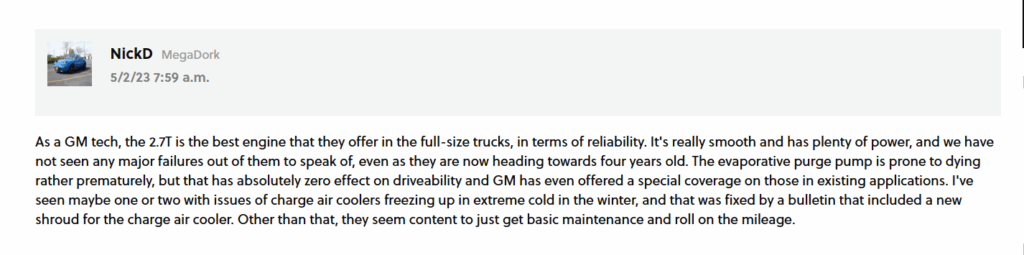
Recalls
So far, GM has issued only a few service campaigns and bulletins for the L3B, mostly related to emissions and calibration rather than mechanical failures. Notable items include:
- Catalytic Converter: Early 2019 Silverado and Sierra models needed an ECM reflash because software glitches could hide catalytic converter faults.
- Fuel Injectors: GM replaced injectors and reprogrammed ECMs on select 2023–24 Colorado, Canyon, Silverado, and Sierra trucks to correct low injector flow.
- Technical Bulletins: Engineers flagged issues like abnormal engine tapping (from worn exhaust lifters) and minor oil leaks on early 2019–21 models. Dealers were instructed to inspect or replace parts as needed, though these weren’t formal recalls.
Is the 2.7L L3B a Good Engine?
So, should you trust the GM 2.7 L3B? Well yes, early results suggest the L3B is a strong and efficient engine that can easily handle the demands of a full-size pickup. As long as you stay on top of regular maintenance, you’re looking at a dependable, high-torque, well-engineered option backed by GM’s warranty and ongoing updates.
It delivers V6 and even V8 levels of torque despite being a smaller package. In fact, it puts out more torque than Ford’s 3.3L V6 and even outperforms some diesels. On top of that, it’s more fuel-efficient than the older V6 in the Silverado.
Of course, there are trade-offs. The L3B is a relatively new and complex engine. Unlike GM’s proven pushrod V8s or the long-running 5.3L, it doesn’t have a long history you can rely on. With its turbo, direct injection, sliding cam, and AFM systems, there are simply more moving parts that could create issues down the road. That said, so far there’s no widespread pattern of failures. Owners on forums largely report smooth performance and no major breakdowns. The key is maintenance, especially sticking to timely oil changes and using quality oil.
So, the trade-offs are acceptable given its benefits: the Silverado with 2.7L weighs hundreds of pounds less than a V8 model, improving payload and economy.