
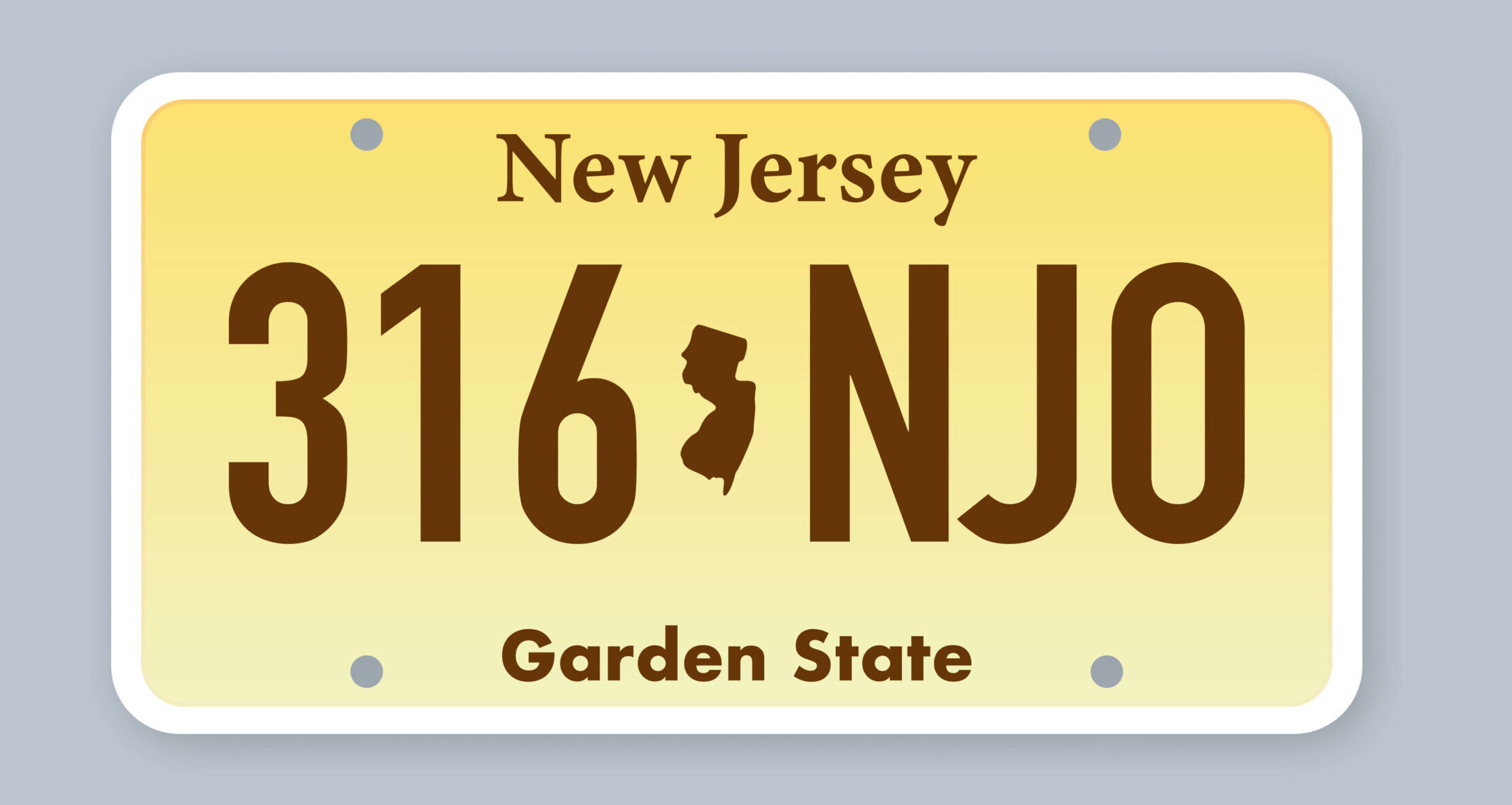

This guide is for New Jersey residents, new car owners, and anyone interested in understanding the state’s license plate system. New Jersey license plates are authorized and designed by the New Jersey Motor Vehicle Commission (NJMVC). Understanding license plate rules helps you stay compliant and avoid fines, ensuring your vehicle is properly registered and legally on the road.
Quick Overview: Main Types of New Jersey License Plates
Here’s a summary of the main license plate types, their appearance, and display requirements:
Plate Type | Appearance/Features | Display Requirement |
|---|---|---|
Standard | Yellow-to-white gradient, black characters, “Garden State” slogan | Two plates (front & rear) |
Personalized | Same as standard, but with custom character combinations | Two plates (front & rear) |
Dedicated (Specialty) | May feature unique colors, emblems, or designs for causes (e.g., organ donation, law enforcement) | Two plates (front & rear) |
Organizational | May feature organization logos, colors, or emblems (e.g., universities, sports teams, veterans) | Two plates (front & rear) |
Historic/Street Rod | “Historic” or “Hot Rod” text, special design for classic/modified vehicles | Two plates (front & rear) |
Motorcycle/Trailer | Smaller plate, rear only | One plate (rear only) |
Temporary | Paper or plastic, issued by dealer or MVC, valid up to 30 days | One plate (rear only) |
- Most vehicles in New Jersey are required to display two license plates, one on the front and one on the rear.
- Specialty license plates in New Jersey may feature different colors or emblems to represent organizations, causes, or universities.
- Motorcycles, trailers, and autocycles require only a single rear plate.
Introduction to License Plates in New Jersey
License plates serve as the official identification for your vehicle and are essential for compliance with New Jersey traffic laws. They help law enforcement and the NJMVC track vehicle ownership, prevent violations, and maintain accurate registration records. You’ll easily recognize New Jersey’s standard license plates by their distinctive yellow-to-white background, bold black letters and numbers, and the “Garden State” slogan at the bottom.
The New Jersey Motor Vehicle Commission (MVC) operates licensing and registration services to ensure all road vehicles have the required identification and documentation. Most vehicles must display plates on both the front and back, while motorcycles, trailers, and autocycles require only a rear plate. This system helps law enforcement and the MVC quickly identify vehicles and supports state regulations.
Now that you understand the general purpose and appearance of New Jersey license plates, let’s explore the specific formats and rules for displaying them.
What Do The Letters On License Plates Of New Jersey Mean: The Format
Every standard license plate for passenger vehicles in New Jersey follows a specific serial format:
- Prefix: One alphabet followed by two digits (e.g., A23).
- Suffix: Three alphabets, making up a three-letter code (e.g., BCD).
The current serial format for New Jersey passenger plates is A12-BCD.
Prefix
- Assigned through an automated process by the New Jersey Motor Vehicle Commission.
- Example: A23.
Suffix
- The first letter of the suffix serves as the root digit.
- Current root digit: ‘U’; Every new license plate issued for passenger vehicles since January 2024 has ‘U’ as the first letter, followed by the next two characters alphabetically.
- Example sequence: UAA, UAB, UAC, etc.
Special Letter Rules
Some letters are reserved or excluded for specific vehicle categories:
- ‘I’: Not used to avoid confusion with the number ‘1.’
- ‘Q’: Reserved for historic and vintage cars.
- ‘T’: Reserved for trailers.
- ‘X’: Reserved for commercial vehicles.
- ‘O’: Reserved for omnibus vehicles.
With the format and letter rules in mind, let’s move on to the different categories of license plates available in New Jersey.
Categories Of New Jersey License Plates
The NJ MVC offers various plate types, including standard, personalized, dedicated, and organizational plates. Here’s what each means:
- Standard Plates: The default plate issued to most vehicles, featuring the classic yellow-to-white gradient and black characters.
- Personalized Plates: Allow you to choose a custom combination of up to seven characters, subject to NJMVC guidelines.
- Dedicated Plates (Specialty Plates): Support specific causes (e.g., organ donation, law enforcement) and may feature unique colors, emblems, or designs.
- Organizational Plates: Represent authorized organizations, such as universities, sports teams, or veterans, and may display logos or special colors.
Specialty license plates in New Jersey may feature different colors or emblems to represent organizations, causes, or universities.
Standard License Plates
These are the most generic and commonly issued license plate types. They have a standard design with the state name at the top, a yellow-to-white background, and a combination of letters and numbers in the A12-BCD format.
Personalized License Plates
Personalized plates allow vehicle owners to select a unique combination of up to seven characters, provided the combination meets NJMVC guidelines and is not offensive. The appearance is similar to standard plates, but with your chosen message. The initial issuance fee is $50.
Dedicated License Plates (Specialty Plates)
Dedicated or specialty plates are designed to support social initiatives and causes, such as organ donation, law enforcement, environmental causes, breast cancer awareness, autism awareness, and animal welfare. These plates often feature unique designs, colors, or emblems. The initial issuance fee is $50, with a $10 annual renewal fee (some exceptions apply).
Organizational License Plates
Organizational plates are similar to dedicated plates but represent authorized organizations in New Jersey, such as colleges, universities, sports teams, and veterans. These plates may display the organization’s logo or colors. Funds generated from these plates support the respective organization.
Sports License Plates
A special category of organizational plates, sports plates allow fans to support their favorite teams (MLB, NHL, NBA, NFL, NASCAR) with team logos or colors. The issuance fee is $50, with a $50 annual renewal fee.
Historic And Street Rod License Plates
- Historic Plates: For classic cars older than 25 years, used exclusively for exhibition and parades. These plates display “Historic.”
- Hot Rod Plates: For modified vehicles older than 25 years, meeting resto-mod standards. These plates display “Hot Rod” and allow normal driving if safety and emissions standards are met.
Historic and hot rod plates have reduced issuance and renewal fees due to their limited use.
Now that you know the different types of plates available, let’s look at how you can obtain one for your vehicle.
Obtaining a License Plate in New Jersey
Required Documents
To register your vehicle and obtain license plates in New Jersey, you’ll need:
- Proof of ownership (e.g., vehicle title)
- Current proof of insurance
- Valid identification (e.g., driver’s license)
- Payment for required fees
Registration Process
- Gather the required documents listed above.
- Visit your local MVC office, register online, or mail your application.
- Submit your documents and pay the applicable fees.
- Receive your license plates.
You can choose from standard, personalized, dedicated, or organizational plates. If your plates are damaged, you can request replacements by surrendering the old plates and paying the replacement fee. You may also transfer your existing plates to a new vehicle if both vehicles are registered under the same name and class.
Plate Display Rules
- Most vehicles require two license plates: one on the front and one on the rear.
- Motorcycles, trailers, and autocycles require only a rear plate.
- Plates must be clearly visible and unobstructed at all times.
The MVC keeps your registration information confidential and does not share it publicly.
With your plates in hand, you may need a temporary solution while waiting for your permanent plates. Let’s see how temporary plates and tags work in New Jersey.
Temporary Plates and Tags
When you purchase a vehicle in New Jersey, temporary plates (temp tags) allow you to drive legally while your permanent registration is processed.
- Issued by: Licensed dealers or directly from the MVC
- Validity: Up to 30 days
- Display: Rear of the vehicle
How to Get Temporary Plates:
- If buying from a dealer, they will issue your temp tags at purchase.
- For private sales, apply for temp tags at the MVC.
Once your permanent plates arrive, remove the temporary tags. Temporary plates keep you legal and road-ready while your paperwork is finalized.
Next, let’s review the full process for registering your vehicle in New Jersey.
Vehicle Registration in New Jersey
Getting your vehicle registered in New Jersey is a straightforward process with the MVC. If you are looking for a wide selection of quality used cars in New Jersey, Schumacher Pre-Owned Vehicles offers inventory from over 5 local dealerships.
Required Documents
- Proof of ownership (title)
- Proof of insurance
- Valid identification
- Payment for registration fees
Registration Process
- Register online, by mail, or in person at an MVC office.
- Submit all required documents and payment.
- Receive your official plate number and registration.
Plate Display Rules
- Most vehicles require two plates (front and rear).
- Motorcycles, trailers, and autocycles require only a rear plate.
- Plates must be properly mounted and current.
If you have old, damaged, or expired plates, surrender them to the MVC. The MVC also offers services for renewals, transfers, and replacements.
If you sell or replace your vehicle, you may need to transfer, replace, or surrender your plates. Here’s how.
How To Transfer Old License Plates On A New Vehicle
If you sell a vehicle and purchase a new one, you can transfer your old plates to the new vehicle if:
- Both vehicles are registered under the same name.
- Both vehicles are in the same class.
Steps:
- Visit an authorized MVC agency.
- Present the new vehicle’s title and registration.
- Request the plate transfer.
How To Replace Damaged New Jersey License Plates
If your plates are damaged or deformed:
Steps:
- Surrender the old, damaged plates at an MVC agency.
- Present required identification.
- Pay the replacement fee:
- $6 for standard plates
- $11 for dedicated or special-interest plates
How To Replace Lost Or Stolen New Jersey License Plates
If your plates are lost or stolen:
Steps:
- Report the loss/theft to local police.
- Obtain a copy of the police report.
- Submit the report and identification at an MVC agency.
- Complete form BA-1.
- Pay the replacement fee:
- $6 for standard plates
- $11 for special/dedicated plates
Keep the verification report as proof you notified the MVC.
How To Surrender License Plates That Are Not In Use
If you no longer need your plates:
Steps:
- Surrender plates at any authorized MVC agency.
- Use the drop box outside the agency.
- Receive a receipt by mail as proof of surrender.
Note: NJMVC does not accept plates from other states.
How Long Can You Drive A Newly-Purchased Vehicle Without License Plates?
- From a dealer: Temporary plates are valid for up to 30 days.
- Private sale: Obtain a temporary registration tag from the MVC.
You must register and obtain permanent plates within this period.
Frequently Asked Questions (FAQ)
Yes, running a New Jersey license plate lookup is legal and complies with the federal Driver’s Privacy Protection Act (DPPA). This service can provide information about a vehicle’s history, including accidents, theft records, title brands, total-loss or salvage records, open recalls, and covers a range of vehicles including trucks.
No, any cover that obscures the plate’s details is prohibited. Using a cover that blocks or distorts the license plate may result in a fine. Plates must remain unobstructed and clearly visible at all times.
Yes, the rear license plate must be illuminated at night and visible from a distance of 50 feet to comply with state regulations.
Autocycles receive only a single rear license plate in New Jersey, similar to motorcycles and trailers.
New Jersey previously used stickers for registration validation on license plates, but has transitioned away from them in favor of electronic and paper documentation.
A proposed bill in early 2024 considers bringing back the nostalgic blue license plate design as an optional choice. Additionally, a commemorative plate celebrating the Declaration of Independence’s 250th anniversary may be available for a $50 initial fee starting in 2026.
Yes, a bill (S160) was introduced in 2024 to require only one license plate on the rear of vehicles.
All passenger plates from 1959 until present are still valid, provided they have been continuously registered.
New Jersey residents have 60 days to title and register their out-of-state vehicle after moving to the state.
While New Jersey has specific requirements for plate display and validation, Canada has its own standards that may differ by province, including the use of front and rear plates, plate design, and registration validation methods.
New Jersey passenger plates use a yellow-to-white gradient with black characters.
By understanding the types, formats, and rules for New Jersey license plates, you can ensure your vehicle is compliant, avoid fines, and even show your support for causes or organizations that matter to you.