

Overview
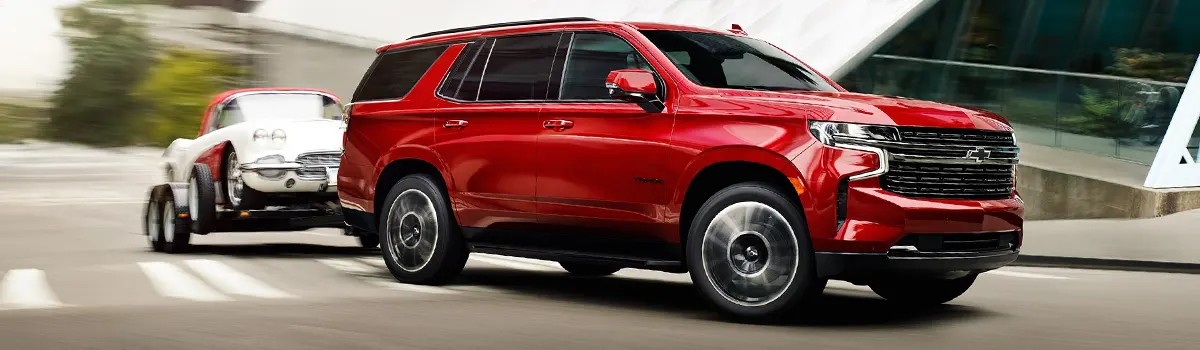
- The Tahoe and Suburban are Chevrolet’s iconic full-size, body-on-frame SUV, each having a strong heritage and loyal following.
- Both models share the GM T1 platform, (debuted with the 2019 Chevrolet Silverado), and now feature independent rear suspensions, which improves ride comfort and third-row legroom.
- While they share nearly everything including what’s under the hood, the Suburban’s extended length—about 15 inches longer than the Tahoe—creates noticeable differences, especially in third-row space and cargo capacity.
- This larger frame does bring slight trade-offs, particularly in fuel economy, towing capacity, and maneuverability, especially in tighter parking spots. Price variations exist across all trims, and since they’re distinct nameplates, each can experience different levels of demand, affecting resale values over time.
Robust truck-based platform, comfortable seating for up to nine passengers, gutsy V8 engines, stout towing and 4WD capability – probably reveals why the full-size Chevy SUV siblings are such a popular large SUV choice even today.
Despite their separate names, the Tahoe and Suburban are essentially the same at heart, with size being the main differentiator.
The Suburban, the longest-running nameplate in the U.S. dating back to 1935, offers spacious room and has served as Chevrolet’s classic large SUV. Meanwhile, the Tahoe emerged in the mid-1990s as a more compact option, catering to those seeking full-size capabilities in a design that’s easier to maneuver and park.
Choosing between these two SUVs can be a challenge, even with their subtle differences. To make your decision easier, we’ve laid out a side-by-side comparison to help you see how each one aligns with your needs and lifestyle.
Difference 1: Price Comparison – Just How Much More Does the Suburban Cost?
- Each trim level of the Chevrolet Suburban is priced exactly $3,000 higher than its counterpart in the Chevrolet Tahoe lineup.
- Both the Suburban and Tahoe come in a similar range of trims, beginning with the base LS model and followed by the LT, RST, Z71, Premier, and the top-tier High Country.
One key distinction between the 2024 Chevy Tahoe and Suburban is their pricing. Since the Tahoe is more compact, it also comes with a friendlier price tag, kicking off at $3,000 less than the Suburban across all trims.
Here’s a breakdown of the starting prices for the 2024 Tahoe and Suburban.
| Trim Level | 2024 Chevrolet Suburban Price | 2024 Chevrolet Tahoe Price | Price Difference (Suburban – Tahoe) |
|---|---|---|---|
| LS | $61,195 | $58,195 | +$3,000 |
| LT | $66,695 | $63,695 | +$3,000 |
| RST | $69,295 | $66,295 | +$3,000 |
| Z71 | $71,295 | $68,295 | +$3,000 |
| Premier | $74,595 | $71,595 | +$3,000 |
| High Country | $81,895 | $78,895 | +$3,000 |
Both models offer a comprehensive set of features as standard right from their base trim. These include LED headlights, keyless entry and Remote start, Power driver and passenger seat, touchscreen infotainment touchscreen with wireless smartphone integration, onboard Wi-Fi hotspot, three-zone automatic climate control, rearview camera, and more. Chevy’s suite of active safety features come standard as well.
Difference 2: Size – How Much Bigger Is the Suburban?
- The Chevrolet Suburban stretches 15 inches longer than the Tahoe, with a wheelbase extended by 13.2 inches.
- At 225.7 inches in length, the Suburban is only slightly shorter than the Silverado 1500 crew cab with a short bed.
The extra length and wheelbase give the Suburban a larger overall footprint than the Tahoe.
Though these SUVs share similar exterior styling, a quick glance at the Suburban’s longer rear window hints at its roomier interior.
Though its size might make tight parking a bit more challenging, you have up to 13 different available camera views at your disposal to help navigate those tricky spots.
| 2024 Chevy Tahoe | 2024 Chevy Suburban | Difference (Suburban – Tahoe) | |
|---|---|---|---|
| Length | 210.7 inches | 225.7 inches | +15 inches |
| Wheelbase | 120.9 inches | 134 inches | +13.1 inches |
| Width (w/o Mirrors) | 81.0 inches | 81.1 inches | Nearly identical |
| Height | 75.8 inches | 75.7 inches | Nearly identical |
Difference 3: Interior Space – How Much More Leg Space Does the Suburban Have?
- The legroom in the first and second rows is identical for both the Tahoe and Suburban.
- However, the Suburban provides an additional 1.8 inches of legroom in the third row, enhancing comfort for rear passengers.
With the mammoth size of the Chevy Tahoe and Suburban comes a cabin with an insatiable appetite for both passengers and cargo, arguably setting the benchmark for spaciousness in this class.
The Suburban and Tahoe are amongst the few options in the market that can be had as a nine-seater SUV, as certain configurations of the Suburban and Tahoe can be equipped with a three-passenger front bench seat, allowing for a total capacity of nine. Most models, however, offer either an eight-passenger layout with front bucket seats and a second-row bench or a seven-passenger configuration featuring second-row captain’s chairs. Regardless of the setup, the third row accommodates three passengers.
Although the Tahoe’s wheelbase is 14 inches shorter than that of the Suburban, it still provides the same generous legroom in the front and second rows. However, the Suburban’s added length does give it a genuine edge in the third row and cargo space.
| 2024 Chevy Tahoe | 2024 Chevy Suburban | Difference (Suburban – Tahoe) | |
|---|---|---|---|
| First-Row Legroom | 44.5 inches | 44.5 inches | 0 inches |
| Second-Row Legroom | 42 inches | 42 inches | 0 inches |
| Third-Row Legroom | 34.9 inches | 36.7 inches | +1.8 inches |
Difference 4: Cargo – Exactly Much More Cargo Space Does the Suburban Pack?
- With all seats folded down, the Suburban offers a maximum cargo space of 145 cubic feet, outpacing the Tahoe’s 123 cubic feet.
What makes the Suburban worth the extra investment for many buyers is precisely this additional cargo room.
You’ll find a lot more space behind the third-row seat, where the Suburban offers 42 cubic feet compared to the Tahoe’s 26 cubic feet. And that advantage only grows when you fold down the flat-folding second and third rows.
| Measurement | 2024 Chevy Tahoe | 2024 Chevy Suburban | Difference (Suburban – Tahoe) |
|---|---|---|---|
| Max Cargo Space | 122.9 cu. ft. | 144.7 cu. ft. | +21.8 cu. ft. |
| Cargo Space Behind Second Row | 72.6 cu. ft. | 93.8 cu. ft. | +21.2 cu. ft. |
| Cargo Space Behind Third Row | 25.5 cu. ft. | 41.5 cu. ft. | +16.0 cu. ft. |
Difference 5: Fuel efficiency – Is the Tahoe Slightly More Fuel Efficient?
- A diverse lineup of powertrain and drivetrain options is available on both the Tahoe and Suburban
Both the Tahoe and the Suburban start with a not so humble 355-hp V8 and go up to a stouter 420-hp V-8. There’s also an optional six-cylinder turbo diesel with a stump-pulling 460 pound-feet of torque.
Each engine is paired with a ten-speed automatic transmission. Rear-wheel drive comes standard while four-wheel drive is optional on most trim levels but standard on the off-road-oriented Z71.
EPA fuel economy is marginally higher on the Tahoe in specific configirations
The fuel economy of the Chevy Tahoe and Suburban are pretty close matched, except for a slight drop for the Suburban with 5.3L V8 engine paired with 4WD and the 3.0-liter turbo six engine in 2WD configuration.
However, keep in mind, these are estimated figures, and the real-world difference could be even more minimal.
| Engine/Configuration | 2024 Chevy Tahoe (MPG) | 2024 Chevy Suburban (MPG) | Difference (Suburban – Tahoe) |
|---|---|---|---|
| 5.3L V8 (2WD) | 15 city / 20 highway | 15 city / 20 highway | 0 city / 0 highway |
| 5.3L V8 (4WD) | 15 city / 20 highway | 15 city / 18 highway | 0 city / -1 highway |
| 6.2L V8 (2WD) | 14 city / 20 highway | 14 city / 20highway | 0 city / 0 highway |
| 6.2L V8 (4WD) | 14 city / 18 highway | 14 city / 18 highway | 0 city / 0 highway |
| 3.0L I6 Turbodiesel (2WD) | 21 city / 28 highway | 21 city / 27 highway | 0 city / -1 highway |
| 3.0L I6 Turbodiesel (4WD) | 20 city / 26 highway | 20 city / 26 highway | 0 city / 0 highway |
Suburban has a higher driving range
One key difference to note is the fuel tank size — the Suburban gas tank holds approximately 28 gallons of fuel while the Tahoe holds about 24 gallons.
Difference 6: Towing Capacity – Is the Tow Capacity Lower on the Suburban?
- Towing numbers for the Tahoe and Suburban are very close, but the Tahoe has a slightly higher maximum towing capacity of 8,400 pounds compared to the Suburban’s 8,300 pounds.
- Surprisingly, the max tow rating is accessible with the less powerful V8 engine on both the SUVs. You will also need the max trailering package to unlock that number.
s a comparison table of the maximum towing capacities for the 2024 Chevy Suburban and Chevy Tahoe based on each engine option:
| Engine | 2024 Chevy Tahoe (Max Towing Capacity) | 2024 Chevy Suburban (Max Towing Capacity) | Difference (Suburban – Tahoe) |
|---|---|---|---|
| 5.3L Ecotec3 V8 (2WD) | 8,400 pounds | 8,300 pounds | -100 pounds |
| 6.2L Ecotec3 V8 (2WD) | 8,300 pounds | 8,200 pounds | -100 pounds |
| Duramax 3.0L Turbo-Diesel (2WD) | 8,200 pounds | 8,100 pounds | -100 pounds |
Difference 7: Reliability and Resale Value: Which One is a Better Buy?
Reliability
Given that the Chevy Tahoe and Suburban share nearly identical structural fundamentals, you can generally expect similar reliability from both models. However, over the past five years, the Tahoe has had a slight edge, often surpassing the Suburban in reliability ratings as per J.D. Power Quality and Reliability data.
However, it’s important to note that reliability data can also vary between both the Chevy full-size SUVs because of the methodology and assessment criteria for the calculation of that data.
Here is the comparison table for JD Power Quality and Reliability Data for the Chevy Suburban and Chevy Tahoe over the last 5 years:
| Year | Chevy Suburban (Reliability) | Chevy Tahoe (Reliability) |
|---|---|---|
| 2024 | 80 | 82 |
| 2023 | 78 | 81 |
| 2022 | 75 | 80 |
| 2021 | 71 | 76 |
Resale
Here is a table comparing the depreciation values of the Chevrolet Tahoe and Suburban using data from ISeeCars and CarEdge.
| Years | ISeeCars – Chevrolet Tahoe Depreciation | IseeCars – Chevrolet Suburban Depreciation | CarEdge – Chevrolet Tahoe Depreciation | CarEdge – Chevrolet Suburban Depreciation |
|---|---|---|---|---|
| 3 Years | 28.5% | 31.9% | 21.46% | 32.09% |
| 5 Years | 50.6% | 54.1% | 47.68% | 47.46% |
| 7 Years | 60.6% | 64.8% | 53.49% | 56.79% |
| 10 Years | 75% | 77.4% | 69.43% | 72.21 |
It is observed that the Tahoe holds its value slightly better than the Suburban in the first three years, with lower depreciation rates in both iSeeCars and CarEdge data. By the fifth year of ownership, both models have nearly similar depreciation.
The trend continues with the Tahoe showing slightly better value retention. By the ten-year mark, both SUVs have depreciated with almost the average rate for a large SUV, but the Tahoe continues to show marginally lower depreciation compared to the Suburban, suggesting it may maintain resale value slightly better than the Suburban over a decade.
Chevy Suburban vs Tahoe – Which One to Buy?
Full-size SUVs, like the Chevrolet Suburban, offer excellent options for those who prioritize space, comfort, and towing capacity. Ideal for large families, frequent cargo carriers, long-distance travelers, and even commercial fleet users, the Suburban is designed to meet substantial passenger and cargo needs.
Ultimately, the choice between the Tahoe and Suburban should align with your lifestyle, balancing comfort, cargo space, and handling ease. If you think the extra space that the Suburban offers in its third row and especially the cargo, is a priority, well the Suburban should be a no-brainer.
Plus, with multiple available camera views and parking assist, you’ll likely only notice the larger size in tight parking situations. And interestingly, the Suburban is actually shorter than a Silverado crew cab pickup with a short bed, so if you’re comfortable driving a Tahoe, the Suburban won’t feel drastically different.
Which Seats More Passengers: Tahoe or Suburban?
Both the Tahoe and Suburban can seat up to nine passengers, though seating configurations vary by trim. Base trims can include a front bench seat for extra capacity, while standard trims offer seating for eight with bench seats in the second and third rows. There’s also a seven-passenger option with captain’s chairs in the middle row.
Does the Suburban Offer More Legroom than the Tahoe?
Yes, the Suburban has an additional 1.8 inches of legroom in the third row compared to the Tahoe, making it slightly more spacious for back-row passengers. The first- and second-row legroom is identical across both models.
Is the Tahoe Mid-Size or Full-Size?
The Chevy Tahoe is a full-size, three-row SUV, capable of seating between seven and nine passengers. Its truck-based platform, derived from the Silverado pickup, gives it the robustness that full-size SUVs are known for. For mid-size options, Chevrolet offers the Traverse and the Blazer.
Is the Chevy Suburban Reliable?
The Chevy Suburban is generally known for its reliability, especially among full-size SUVs. The Suburban is the second-ranked longest-lasting vehicle according to iSeeCars.
What’s the GMC Version of the Tahoe and Suburban?
The GMC counterparts are the Yukon (similar to the Tahoe) and the Yukon XL (similar to the Suburban). Both GMC models share the same key differences in size and features as the Tahoe and Suburban.
Which Third Row is More Comfortable: Suburban or Tahoe?
The Suburban’s third row offers 1.8 extra inches of legroom over the Tahoe, making it a bit more comfortable. However, it is not a day and night difference, and Tahoe still offers one of the best third-row spaces and comfort in the class where you can actually fit an adult instead of just kids.
When did the Chevy Suburban and Tahoe first come out?
The Suburban’s legacy began in 1935, initially serving as a military transport during WWII. The Tahoe, on the other hand, was introduced in the mid-1990s. It was based on the eight-generation Suburban – designed with a shorter body for improved handling.